






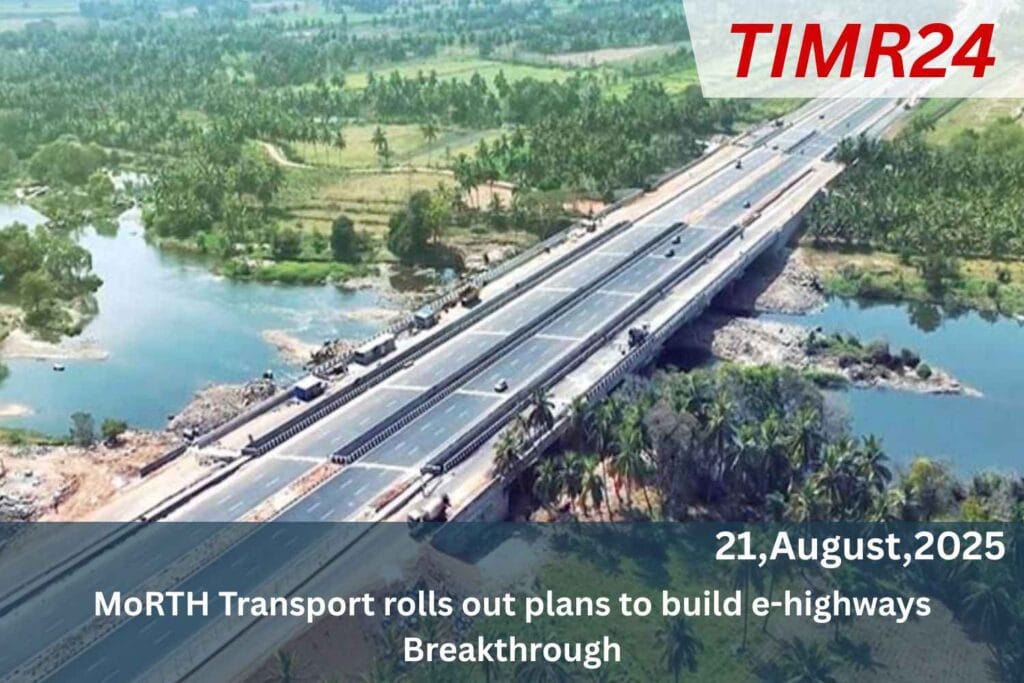
The MoRTH Union Transport Ministry plans to develop India’s first electric highway between Delhi and Jaipur, citing economic viability. Transport Minister Nitin Gadkari supports the project, stating it can provide electricity to government companies at a lower cost. The ministry is negotiating with the power ministry to secure electricity at a lower rate. The Ministry of Road Transport and Highways (MoRTH) has taken a transformative step by unveiling plans to build e-highways in India, a move that signals the country’s intent to accelerate the shift towards sustainable mobility. With the rapid growth of electric vehicles (EVs), the government aims to ensure that highways are not just connectors of cities but also enablers of clean and green transportation.
This initiative will redefine the way people travel long distances, while simultaneously supporting India’s net-zero emission targets and reducing dependency on fossil fuels The concept of e-highways is built around the integration of charging infrastructure along major national corridors, allowing EVs both passenger and commercial—to travel without concerns about running out of power (National Highways) For MoRTH, this is not just an infrastructure project but a mission to create a future-ready ecosystem for mobility. By aligning with India’s National Electric Mobility Mission Plan and the ongoing National Highway Development Program, these e-highways will act as catalysts in boosting EV adoption across the country.
One of the key aspects of this plan is to prioritize freight corridors and high-density traffic routes, where commercial vehicles contribute significantly to fuel consumption and emissions. By enabling e-highway systems on stretches like the Delhi-Mumbai Expressway, the Golden Quadrilateral, and upcoming economic corridors, the government aims to create seamless pathways for heavy-duty electric trucks and buses. Such integration will not only reduce operational costs for logistics companies but also enhance efficiency in supply chain networks. Readers can also explore the relevance of these developments in the context of India’s logistics sector which has been undergoing digital and infrastructural transformation.
Beyond logistics, the e-highways are expected to serve as a backbone for intercity passenger travel. The establishment of fast-charging stations, solar-powered charging hubs, and intelligent traffic management systems will make long-distance EV travel more reliable. As seen in similar global initiatives in countries like Germany and Sweden, where e-highways have been tested successfully, India is preparing to adapt international best practices to its unique geography and mobility patterns. With MoRTH at the forefront, these e-highways will bring India closer to becoming a leader in green mobility infrastructure.
The financial and environmental implications of this move are profound. On the one hand, reducing crude oil imports will help strengthen India’s energy security. On the other, promoting electric transportation will directly contribute to lowering carbon emissions in line with the Paris Agreement commitments. According to industry experts, e-highways will also stimulate investments in EV manufacturing, battery technologies, and renewable energy integration. This is closely connected to initiatives like the Production-Linked Incentive (PLI) scheme for advanced chemistry cells, which supports the development of domestic battery manufacturing capacity.
Another noteworthy aspect is the synergy between e-highways and smart city development. As urban centres expand, the integration of clean transportation systems with modern city infrastructure becomes essential. Cities like Delhi, Bengaluru, and Pune, which are already leading in EV (MoRTH) adoption, are likely to benefit significantly from e-highway connectivity, creating a smooth transition between urban mobility solutions and intercity travel. Interested readers can check out the details of India’s Smart Cities Mission, which highlights how sustainable transport is a critical part of future urban planning.
However, building e-highways also comes with challenges. The initial investment in charging infrastructure, grid connectivity, and land availability is substantial. Moreover, standardizing charging technologies and ensuring interoperability between different vehicle models is crucial for widespread acceptance. MoRTH is expected to collaborate closely with state governments, private investors, and global technology providers to overcome these hurdles. The success of projects like PM Gati Shakti National Master Plan, which focuses on integrated infrastructure development, can serve as a guiding framework for the e-highway rollout.
Q1. What are e-highways?
E-highways are smart roads equipped with EV charging infrastructure to enable seamless long-distance electric vehicle travel.
Q2. Why is MoRTH building e-highways?
To promote clean mobility, reduce fossil fuel dependence, and support India’s sustainable transport vision.
Q3. Which routes will be developed as e-highways first?
Key national highways and freight corridors will be prioritized for e-highway development.
Q4. How will e-highways benefit EV users?
They ensure fast charging, reduce range anxiety, and make intercity EV travel more convenient.
Q5. When will India’s first e-highway be operational?
Pilot projects are expected soon, with phased rollouts across major routes in coming years.