
















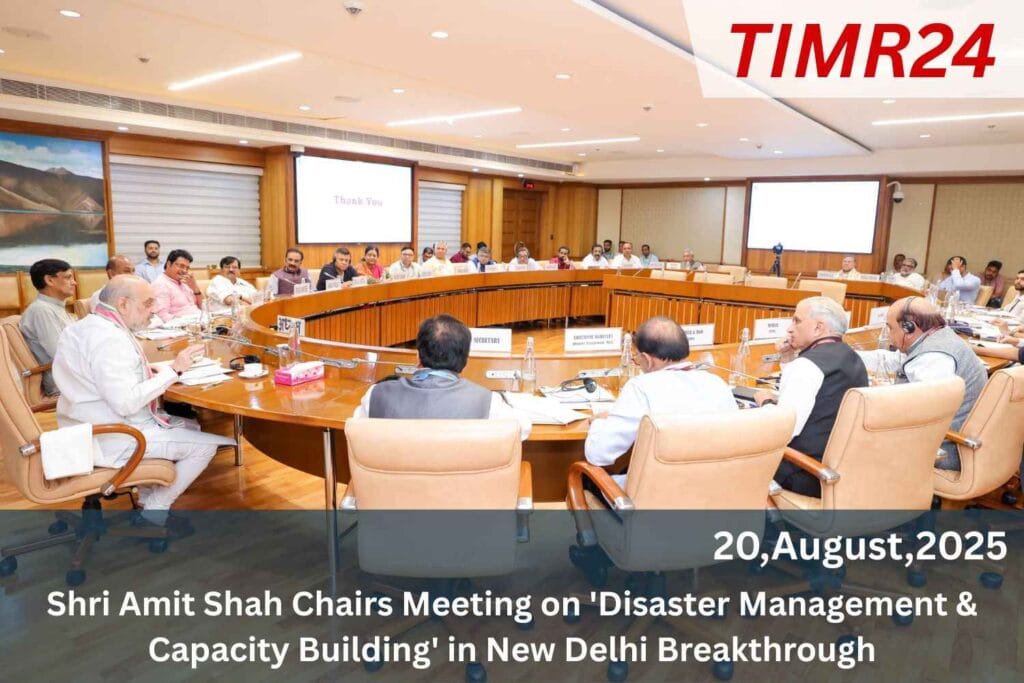
India’s Union Home Minister and Minister of Cooperation Amit Shah has emphasized the country’s shift from a relief-centric to a rescue- and prevention-focused approach in disaster management. The new policy focuses on capacity building, speed, efficiency, and accuracy, resulting in a 98% reduction in cyclone-related damage and zero casualties. The government has tripled disaster funding, with ₹2 lakh crore allocated to SDRF and NDRF from 2014-2024. Major initiatives include NDMA technology adoption, NDRF execution, cyclone shelters, fire services modernization, and the Common Alerting Protocol system. Union Home Minister Shri Amit Shah recently chaired a high-level meeting in New Delhi on Disaster Management and Capacity Building, highlighting the government’s
Commitment to strengthening national preparedness against natural and man-made disasters. The meeting brought together senior officials from the Ministry of Home Affairs, the National Disaster Management Authority (NDMA), and representatives from various state disaster management bodies (Infar’s Solar) The discussions revolved around strategies to improve resilience, build institutional capacity, and integrate modern technology in disaster risk reduction. With India’s geographical diversity making it vulnerable to earthquakes, floods, cyclones, and heatwaves, the emphasis on proactive measures is seen as a crucial step towards reducing the impact of such calamities.
A major part of the meeting focused on capacity building initiatives, where Shri Amit Shah underlined the need for skill development, specialized training, and cross-agency coordination. The National Institute of Disaster Management (NIDM) and NDMA have been actively conducting programs to enhance the efficiency of first responders, state-level authorities, and community volunteers. This aligns with the government’s larger vision under the National Disaster Management Plan that stresses not only post-disaster relief but also pre-disaster preparedness. For readers interested in related policies, you can explore how are shaping disaster risk reduction at multiple levels.
Technology-driven solutions were another key highlight, with Shri Amit Shah urging the use of artificial intelligence, GIS mapping, satellite communication, and early warning systems to predict and respond more effectively to emergencies. In recent years, India has adopted advanced forecasting models to reduce the damage caused by cyclones and floods, particularly in coastal regions. This discussion resonates with parallel efforts in the renewable energy sector, as seen in projects like where technology integration is also a driving force for sustainable development.
The meeting also touched upon the importance of community participation, recognizing that disaster management cannot succeed without local engagement. By involving Panchayati raj institutions, local self-help groups, and non-governmental organizations, the government aims to empower citizens at the grassroots level. This community-based approach has proven effective in states like Odisha, which have significantly improved cyclone preparedness. The Home Minister stressed that awareness campaigns, school safety programs, and regular mock drills must be prioritized to create a culture of safety and readiness. To understand how similar initiatives improve rural systems, you may read about where community involvement plays a pivotal role.
Financial preparedness was another critical aspect, with discussions on creating a stronger disaster response fund and ensuring that state governments have adequate resources to respond swiftly. The importance of public-private partnerships was also emphasized, given that infrastructure resilience and business continuity planning are becoming increasingly important in today’s interconnected economy. A recent example of financial structuring can be seen in (Revised HAM) in the road sector, where policy reforms aim at long-term sustainability—paralleling the resource allocation needed in disaster management.
Shri Amit Shah also highlighted the global context of disaster management, pointing out that India has been at the forefront of international cooperation through platforms like the Coalition for Disaster Resilient Infrastructure (CDRI). He urged that India’s learnings, particularly in handling large-scale natural disasters, should be shared with other countries, while also adapting best practices from around the world. This approach strengthens India’s position as a leader in humanitarian response and resilience planning. Much like India’s role disaster management too requires cross-border learning and collaborative frameworks.
The meeting concluded with a roadmap that outlines short-term, medium-term, and long-term strategies. Short-term measures involve enhancing early warning dissemination and conducting training exercises, while medium-term plans focus on building stronger infrastructure and integrating new technologies. Long-term strategies emphasize climate change adaptation, environmental protection, and strengthening legislative frameworks that support disaster risk governance. This structured planning ensures that India is not just reacting to disasters but is moving towards a preventive and resilient framework.
In summary, the meeting chaired by Shri Amit Shah in New Delhi reflects a comprehensive vision for disaster management in India. It emphasizes technology adoption, community involvement, financial preparedness, and global cooperation, ensuring a holistic approach towards building resilience. With proactive steps such as capacity building programs, strengthening institutional frameworks, and encouraging Innova.
Q1. What was the main focus of Shri Amit Shah’s meeting on Disaster Management?
The meeting focused on preparedness, resilience, and capacity building for effective disaster management.
Q2. Where was the meeting on Disaster Management chaired by Shri Amit Shah held?
The meeting was held in New Delhi.
Q3. Why is capacity building important in disaster management?
It strengthens response systems, improves training, and enhances coordination during emergencies.
Q4. Who participated in the disaster management meeting chaired by Amit Shah?
Senior government officials, disaster management authorities, and key stakeholders attended.
Q5. What outcomes are expected from this meeting?
The meeting aims to improve preparedness, strengthen institutions, and ensure better coordination in disaster response.