






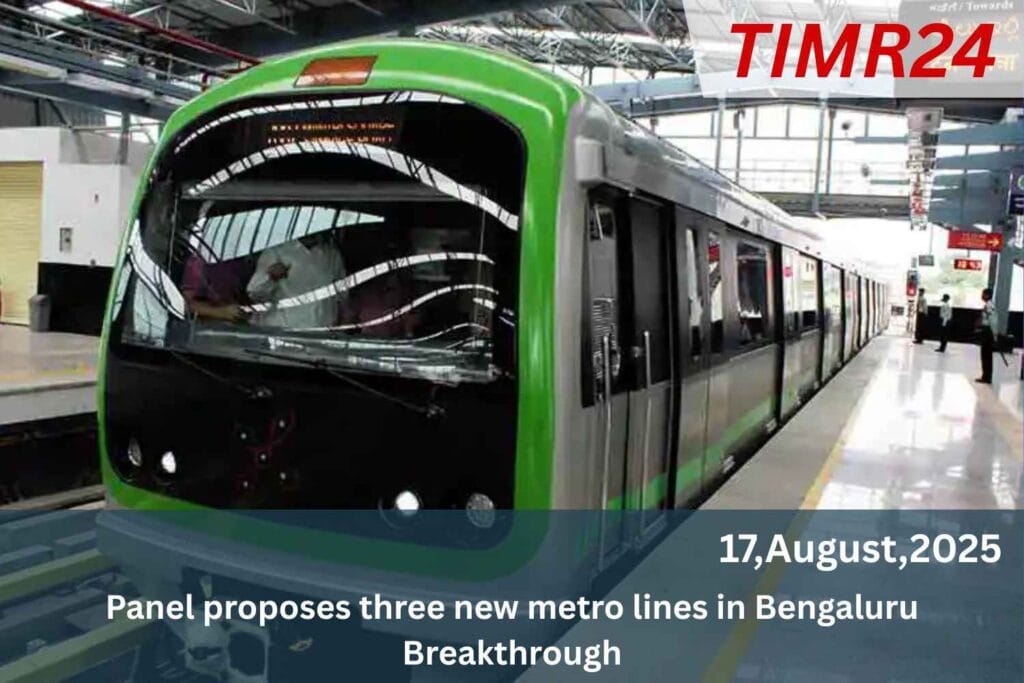
A panel from the state government and FICCI has proposed three new corridors for the Bengaluru metro network, aiming to enhance connectivity and accessibility for travellers. The proposal also includes plans to increase connectivity with nearby railway networks, covering 452 km, serving cities in and around Bangalore. Bengaluru, the bustling tech capital of India, has long grappled with escalating traffic congestion, prompting urgent calls for enhanced public transportation solutions. In response, a government has proposed the development of three new metro corridors to alleviate the city’s mobility challenges and promote sustainable urban growth. The proposed corridors are strategically designed to bridge critical gaps in Bengaluru’s existing metro network.
The first corridor aims to connect MG Road to Hope Farm via Old Airport Road, Marathahalli, and Whitefield. This alignment is poised to serve key commercial and residential areas, facilitating smoother commutes for professionals and residents alike. The second corridor focuses on enhancing connectivity along Old Madras Road, linking KR Puram to Hosket. This route is expected to cater to the growing demand for transportation in the eastern parts of the city, providing a vital link to industrial zones and easing traffic on arterial roads. The third proposal introduces an Inner Ring Road Loop, encompassing Yeshwantpur, Cantonment, Indiranagar, Koramangala, Ashoka Pillar, and Mahalakshmi Layout.
This loop aims to create a seamless transit experience, connecting diverse neighbourhoods and reducing travel time across central Bengaluru. These proposed corridors are designed to integrate seamlessly with Bengaluru’s existing metro lines, including the Green, Purple, and Yellow Lines (Namma Metro) Such integration ensures a cohesive and efficient public transportation network, allowing passengers to transfer effortlessly between lines and reach their destinations with minimal delays. Beyond improving daily commutes, the expansion of the network is expected to have significant environmental and economic benefits. By providing an efficient alternative to private vehicles.
Challenges and Considerations
the system can contribute to reduced traffic congestion, lower emissions, and decreased dependence on fossil fuels. Economically, enhanced connectivity can spur growth in underdeveloped areas, attract investments, and create employment opportunities. While the proposed metro corridors promise substantial benefits, their successful implementation will require addressing several challenges. (Metro Expansion) Land acquisition, environmental clearances, and coordination with existing infrastructure are critical factors that need meticulous planning and execution. Additionally, ensuring that the new lines cater to the needs of all socio-economic groups, including marginalized communities, is essential for equitable urban development.
The proposal for three new corridors in Bengaluru represents a forward-thinking approach to urban mobility. By enhancing connectivity, reducing congestion, and promoting sustainable transportation, these initiatives align with the city’s aspirations to become a model of smart urban development. As planning progresses, it is imperative that stakeholders collaborate to overcome challenges and realize the vision of a well-connected, efficient, and environmentally friendly Bengaluru. Bengaluru, the bustling tech capital of India, has long grappled with escalating traffic congestion, prompting urgent calls for enhanced public transportation solutions.
Q1. What are the new metro lines proposed in Bengaluru?
The panel has proposed three new metro lines to expand the city’s metro network.
Q2. What areas will the new metro lines cover?
The proposed lines aim to connect key residential, commercial, and IT hubs for better city-wide accessibility.
Q3. When will construction of the new metro lines begin?
The project is in planning stages; official timelines will be announced after approvals and funding are finalized.
Q4. How will the new metro lines benefit commuters?
They will reduce traffic congestion, shorten travel time, and improve connectivity across Bengaluru.
Q5. Who is overseeing the planning of these metro lines?
The Bengaluru Metropolitan Transport Corporation (BMTC) and related urban development authorities are managing the planning.