






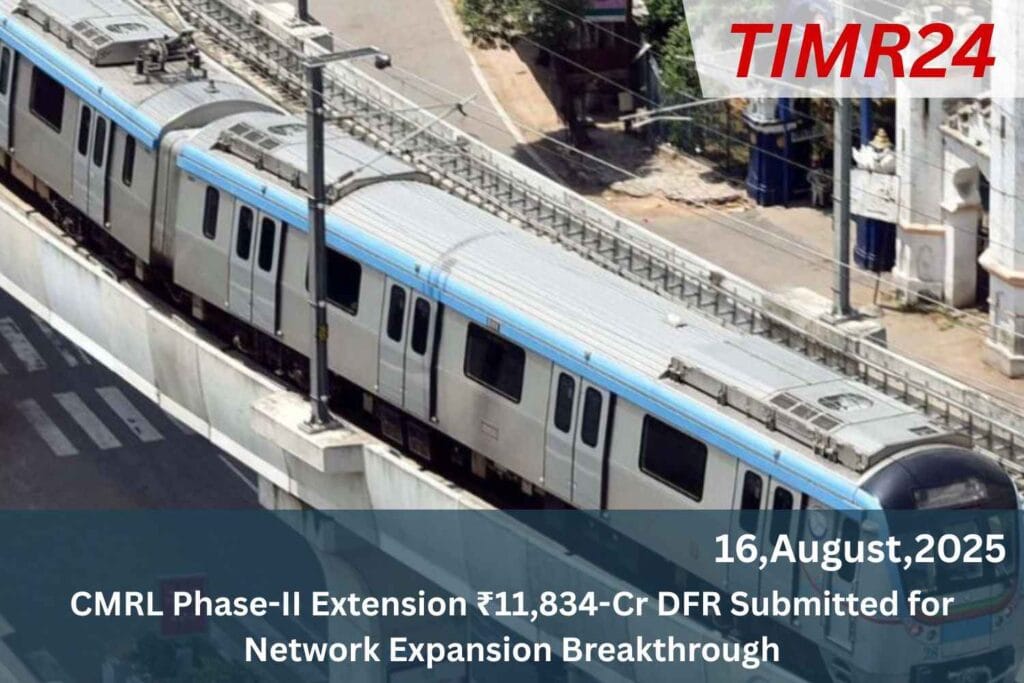
CMRL Chennai Metro Rail Limited has submitted DFRs for the extension of Corridors 3 and 5 under Phase II of the Chennai Metro, involving a combined investment of Rs.11,834 crore, covering 23.5 km and 16.07 km respectively. The Chennai Metro Rail Limited (CMRL) has taken a significant step forward in expanding the city’s public transport network by submitting the Detailed Feasibility Report (DFR) for its Phase-II extension. With an estimated investment of ₹11,834 crore, this project is not just a technical upgrade but a strategic move to enhance connectivity, reduce road congestion, and integrate suburban regions into Chennai’s rapid transit framework. The extension, once completed, will complement.
The ongoing Phase-II corridors and strengthen the city’s position as one of India’s leading urban mobility models The Chennai Metro currently operates in two major phases, with Phase-I connecting crucial corridors between The airport, city centre, and industrial hubs. Phase-II, which is already under various stages of execution, is designed to expand this reach even further. The newly proposed extension under the DFR aims to connect peripheral areas that have seen rapid growth but remain underserved by high-capacity public transport. This follows the city’s broader transport vision of shifting more commuters from private vehicles to reliable mass transit. (Chennai Metro) submitted DFR,
The Phase-II extension will cover additional stretches branching out from existing corridors. While the final alignment will depend on detailed engineering surveys and public consultations preliminary plans indicate improved access to residential clusters, IT hubs, and industrial belts The design also focuses on intermodal connectivity, ensuring that passengers can seamlessly transfer between metro suburban rail, and bus networks. This is in line with similar integration efforts seen in other urban transport projects The ₹11,834-crore cost estimate includes civil works, rolling stock procurement, signalling systems, station construction, and related infrastructure. Funding is expected to be sourced from a combination of state government allocations, central government support under urban transport
Schemes, and loans from multilateral agencies such as JICA or ADB, both of which have previously partnered with CMRL. The project is likely to be implemented in multiple packages to allow parallel construction and reduce overall completion time. The benefits of the Phase-II extension extend beyond transport convenience. By improving connectivity to emerging residential zones and employment hubs, the metro will play a direct role in boosting property values, attracting commercial investments, and enhancing overall urban liveability. Additionally, the shift from private to public transport will help reduce vehicular emissions, contributing to
Chennai’s climate resilience goals The social inclusion aspect is also significant affordable metro fares will provide better access for low-income commuters from outlying areas, enabling them to participate more actively in the city’s economy. Urban transport projects like this metro extension are closely linked to land use planning. The Chennai Metropolitan Development Authority (CMDA) has been working to align metro expansion with transit-oriented development (TOD) principles, promoting high-density, mixed-use development around stations. This integration not only optimises metro ridership but also reduces the city’s dependence on road-based transport. Lessons from other Indian metro cities have shown that TOD, when implemented effectively, can lead to vibrant, walkable neighbourhoods and improved urban quality of life. (CMRL)
Challenges and Timeline
Despite the optimism, large-scale infrastructure projects often face challenges such as land acquisition delays, utility shifting, and environmental clearances. The CMRL has a track record of addressing such issues through early-stage planning and stakeholder engagement. If approvals and funding are secured within the next year, construction for the Phase-II extension could begin by late 2026, with phased openings starting around 2030. With Chennai’s population and economic footprint rapidly growing, expanding its metro network is not just a choice but a necessity. The Phase-II extension, supported by modern engineering, sustainable transport planning, and robust financing, will play a pivotal role in shaping the city’s mobility for decades to come. Once operational.
Q1. What is the cost of CMRL’s Phase-II extension?
The Detailed Feasibility Report estimates ₹11,834 crore.
Q2. Which areas will be covered in this extension?
It will connect underserved suburban and peripheral areas to the main network.
Q3. Who prepared the Detailed Feasibility Report (DFR)?
The Chennai Metro Rail Limited (CMRL) prepared it.
Q4. What is the main aim of this project?
To improve connectivity and reduce road traffic congestion in Chennai.
Q5. When will construction begin?
Construction is expected after final approvals and funding arrangements.