


















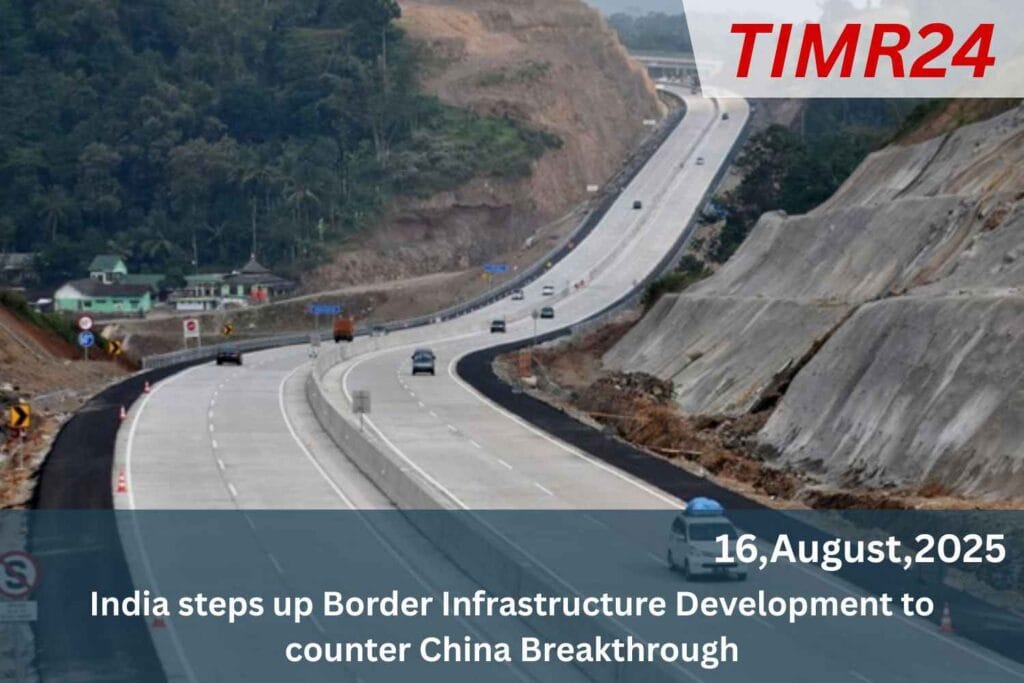
India has launched 90 projects to bridge the border infrastructure gap with China, including the Neiphiu tunnel, revamped airfields, helipads, 22 roads, and 63 bridges. Defence Minister Rajnath Singh inaugurated these projects, including the upgrade of the Nyoman advance landing airfield and the 423-metre Devaki bridge. The projects, costing Rs 2,941 crore, are spread across 11 states and UTs, following the completion of 103 projects in 2022 and 102 in 2021. India has significantly accelerated its border infrastructure development to strengthen defence preparedness and counter China’s growing presence along the Line of Actual Control (LAC). This initiative is not merely about building roads and bridges it is a comprehensive strategy aimed at improving troop mobility,
Enhancing logistics, and ensuring that military forces can respond rapidly to any border challenges The government’s recent push, backed by increased budget allocation and fast-track approvals, is transforming remote and previously inaccessible areas into strategically connected zones. The move also complements India’s broader national security framework, aligning with its long-term geopolitical vision and diplomatic engagements with neighbouring countries. For readers following defence policy trends, this development ties closely with earlier efforts and armed forces facilities, reflecting a consistent approach towards securing borders.
One of the critical aspects of this Infrastructure expansion is the focus on high-altitude roads and tunnels, particularly in regions like Ladakh, Arunachal Pradesh, and Sikkim. These areas, often plagued by extreme weather and limited accessibility, have historically faced challenges in maintaining year-round connectivity. Projects such as the construction of all-weather tunnels, steel bridges capable of carrying heavy military equipment, and upgraded border outposts are already showing visible impact. These upgrades are essential not only for defence movement but also for supporting local communities in remote areas, boosting trade, tourism, and economic opportunities. This dual civilian-military benefit echoes the principles seen in [border area development programmes] where infrastructure serves both national security and local welfare.
The urgency of these developments stems from the evolving dynamics along the India-China border. In recent years, China has been rapidly expanding its own infrastructure on its side of the LAC, including high-speed roads, airstrips, and logistics hubs. India’s response is therefore strategic and necessary, ensuring that there is no asymmetry in operational readiness. This mirrors similar strategies adopted in (GOVERNMENT OF INDIA) where infrastructure acts as a deterrence as much as a support system. The government has also leveraged advanced technology in construction—such as prefabricated structures, automated monitoring systems, and drone-based surveying—to speed up project completion and maintain precision in challenging terrains.
The Border Roads Organisation (BRO) plays a pivotal role in this mission. Over the past few years, the BRO has set new records in road construction, with many projects completed ahead of schedule. It has also adopted modern construction techniques to tackle the difficult Himalayan geology and unpredictable weather patterns. This is part of a larger trend in India’s [defence infrastructure modernisation], where efficiency, speed, and sustainability are key performance indicators. The introduction of green building practices, renewable energy sources for remote posts, and environmentally sensitive designs shows that the development is not just aggressive but also responsible.
Beyond the physical structures, India is also integrating these infrastructure upgrades with improved surveillance and communication systems. The deployment of advanced radars, satellite-linked monitoring, and secure communication lines ensures that the newly built roads and facilities are supported by real-time intelligence capabilities. This integration aligns with the digital transformation underway in (Infrastructure) where technology and infrastructure go hand in hand. The synergy between physical readiness and digital oversight makes the border security framework far more resilient and responsive. Diplomatically, the push for border infrastructure sends a clear signal without escalating tensions unnecessarily. India continues to engage China through
military and diplomatic channels to resolve disputes peacefully, but it is simultaneously ensuring that it is not strategically disadvantaged. This balanced approach is consistent with India’s [foreign policy in Asia], where assertiveness is paired with dialogue. Additionally, regional cooperation with countries like Bhutan and Nepal on infrastructure sharing and connectivity further strengthens India’s position in the Himalayan region The socio-economic impact of this development cannot be overlooked. Improved connectivity in border regions means better access to education, healthcare, and markets for local residents. It also encourages reverse migration, as people find more opportunities closer to home. Tourism in scenic yet previously inaccessible areas is also likely to grow, bringing new streams of income.
These benefits reinforce the idea that border development is not just a military necessity but also a driver of inclusive growth an idea that has been central to India’s. In essence, India’s accelerated border infrastructure development is a multifaceted breakthrough. It addresses immediate security concerns, matches China’s pace of expansion, uplifts local economies, and integrates advanced technology into national defence operations. As projects continue to progress at record speeds, the coming years are likely to witness a transformed border landscape one where security, connectivity, and economic vitality coexist. This transformation will not only redefine India’s border readiness but also shape its strategic posture in the broader Asian security environment.
Q1. Why is India enhancing border infrastructure?
To strengthen security and improve troop mobility along the China border.
Q2. What projects are included in the plan?
Roads, bridges, tunnels, and advanced surveillance systems.
Q3. Which areas are prioritized?
Ladakh, Arunachal Pradesh, and other key Line of Actual Control (LAC) zones.
Q4. How will this impact defence readiness?
It ensures faster troop deployment and better logistical support.
Q5. Is this development a response to China?
Yes, it counters China’s growing infrastructure near the LAC.