










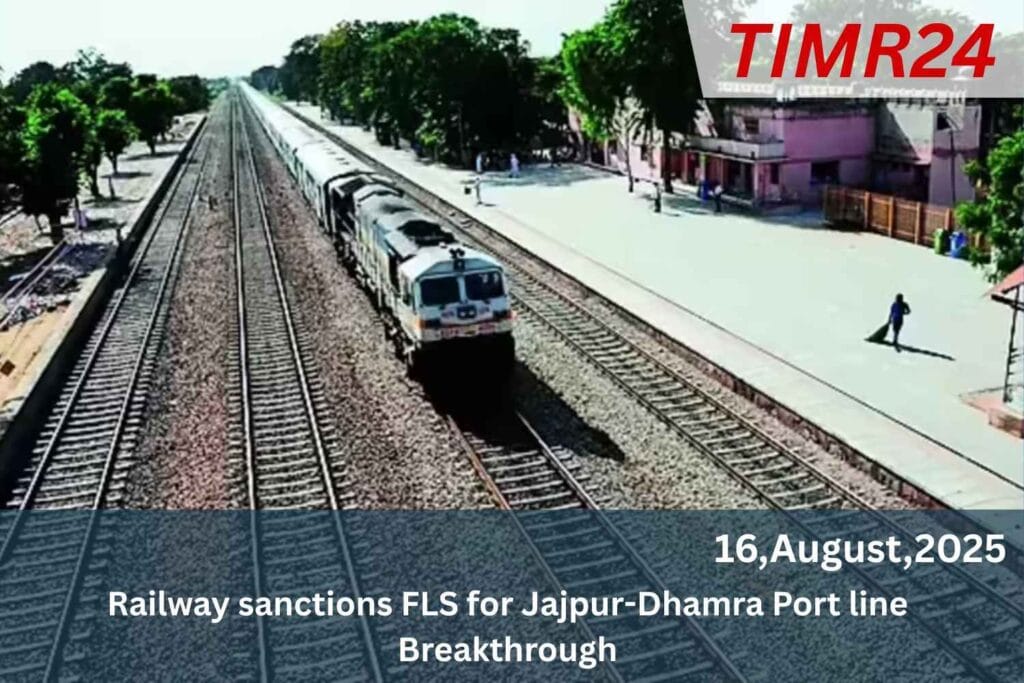
The Union Government has sanctioned a Final Location Survey for a 96 km Railway line between Jaipur Road-Keonjhar and Dhamra, with an allocation of Rs 2.4 crore. The line will connect religious and tourist destinations, and serve as an alternative route. The recent decision by the Ministry of Railways to sanction the Final Location Survey (FLS) for the proposed 96-kilometer rail line linking Jajpur Keonjhar Road and Dhamra Port marks a pivotal moment in Odisha’s infrastructure growth—a development that promises to intertwine economic prowess with cultural connectivity. The FLS, allocated ₹2.4 crore by rail authorities, represents a meticulous phase in project execution: an in-depth topographical, geological, and environmental assessment that lays the groundwork for an eventual construction tender.
Without explicitly stating “Final Location Survey” repeatedly, this approval signals India’s resolve to bring tangible rail infrastructure to regions long awaiting such momentum Rooted in sustained community aspirations, the envisioned line responds to decades of local advocacy from the people of Jajpur, Bhadrak, and Kendra Para districts. For many villagers and town dwellers, the vision of seamless rail connectivity is a door to improved quality of life: easier access to urban centres, smoother transport of goods, and visitation to revered cultural monuments. Pilgrims, for example, will find enhanced reach to the Akhandalamani Temple at Aradi Patha and Biraj Khatri in Jajpur town, destinations that have, until now, remained somewhat remote despite their spiritual significance.
industrial belts in Jajpur
Beyond spiritual journeys, the rail line embodies a strategic artery for Odisha’s industrial corridor. As advocates have articulated in public meetings and local media, the corridor will serve as a freight conduit—streamlining movement of minerals from Keonjhar district, facilitating finished goods from industrial belts in Jajpur and Angul, and enhancing access to the deep-water capabilities of Dhamra Port (Railways) Indeed, the port developed as a modern export hub with world-class handling capacities and rail access to Bhadrak will become more seamlessly integrated into the nation’s rail freight network, reinforcing Odisha’s export infrastructure This initiative is not isolated; it is firmly embedded in broader national ambitions.
The scheme aligns with the Parody vision, an Eastern India-focused development plan championed by the Prime Minister, aimed at elevating regional infrastructure and prospects The rail line has also enjoyed high-level political support Union Education Minister Dharmendra Pradhan has been vocal in his endorsement, and Railway Minister Ashwini Vaishnaw, during visits to Jajpur and Bhadrak, pledged to fast-track planning and investments This narrative one of local demand, strategic logistics, cultural preservation, and political will captures a multi-layered transformation What once was a distant aspiration for better transport links is now on the cusp of coming alive, pending the FLS outcome. That survey will establish the precise alignment threading through sensitive environmental zones, economically vital industrial.
Stretches, and revered cultural sites while incorporating engineering feasibility, land-acquisition requirements, and ecological safeguards. In historical perspective, the move is part of a larger tapestry of Odisha’s rail expansion. Existing infrastructure such as the single-track line connecting Bhadrak to Dhamra, opened in 2011, laid initial groundwork for port access The new project, however, is poised to elevate that access from selective siding usage to comprehensive, high-capacity connectivity. Streets, villages, and industries along the proposed route may witness land-use changes, real-estate activity, and micro-economic stimulus well before rails are even laid. Yet the concept also prompts reflection on environmental stewardship.
The coast of Odisha is ecologically sensitive, marked by fragile mangrove tracts and the migratory habitats of Olive Ridley turtles. While the FLS will primarily chart technical contours, its underlying environmental inputs could critically influence route decisions and future mitigation strategies, especially given the port’s geographic proximity to conservation zones (Dhamra Port). Thus, the sanction of the FLS is more than a financial nod it is a convergence of community voice, commercial foresight, cultural preservation, and political architecture. It lays numerical and technical foundations for a rail corridor that, in years to come, may become a backbone of freight transit, a pilgrim’s pathway, and a catalyst for regional growth.
Q1. What is the Jajpur–Dhamra Port rail project?
A proposed rail link to improve freight and passenger connectivity between Jajpur and Dhamra Port.
Q2. What does FLS approval mean?
FLS (Final Location Survey) is the detailed study before construction, marking a major project milestone.
Q3. Why is this line important?
It will boost port connectivity, support trade, and ease cargo transport in Odisha.
Q4. Who will benefit from this project?
Industries, exporters, importers, and local communities along the route.
Q5. When will construction begin?
It will start after survey completion, approvals, and funding arrangements.