















Knight Frank India’s India Warehousing Market Report shows a 42% YoY surge in leasing volumes to 32.1 million square feet across the top eight1 markets. The manufacturing sector saw a 71% YoY growth in space uptake, accounting for 45% of the total transactions. The report highlights India’s growing role as a resilient, consumption-led, and manufacturing-driven economy, benefiting from global trade realignments, government-led infrastructure, and PLI investments. The manufacturing sector became the leading occupier during H1 2025, accounting for 45% of all transactions. The pan-India stock exceeded 500 million square feet in H1 2025, with Grade A assets constituting 75% of new supply.
3PL firms absorbed 8.7 million square feet, rising 30% YoY, with Mumbai constituting 35% of the sector’s transacted volumes. E-commerce made a strong comeback with 3.3 million square feet, a 61% increase over the previous year. Transaction volumes grew across all cities except Kolkata, with Mumbai leading with 7.5 million square feet, up 63% YoY. The warehousing and industrial market crossed 513 million (Indian logistics) square feet in H1 2025, with 26.9 million square feet becoming operational across the top eight markets. Grade A properties constituted 75% of the new supply, reflecting developer response to occupier preference for high-specifications, ESG-aligned spaces. Rents rose steadily across markets, with Mumbai, Kolkata, and Pune leading the way.
India’s warehousing sector has entered a phase of rapid expansion, driven by structural shifts in supply chain management, the rise of e-commerce, and policy reforms that have improved logistics efficiency. According to the latest Knight Frank India report, warehouse space demand across major cities recorded a remarkable 42% year-on-year growth in the first half of the fiscal year. This surge is not merely a cyclical trend but a reflection of fundamental changes in how goods are stored, moved, and delivered in the country. Businesses are prioritizing larger, more technologically advanced storage hubs to keep pace with consumer expectations and operational efficiency (India Infrastructure).
E-Commerce and Retail Driving Growth
A significant portion of the warehousing boom can be attributed to the aggressive expansion of e-commerce players and organized retail chains. Online marketplaces are not only increasing their storage capacities in metro cities but also penetrating tier-2 and tier-3 towns to meet regional demand faster. This shift has created a need for last-mile delivery hubs and strategically located fulfilment centres. With consumer behaviour leaning heavily towards same-day or next-day delivery, companies are investing in logistics infrastructure that can reduce lead times. The retail sector, including both food and non-food segments, has also witnessed accelerated demand for modern storage facilities, contributing to the overall sectoral momentum.
The government’s emphasis on ‘Make in India’ and production-linked incentive (PLI) schemes has encouraged manufacturing industries to scale up production. This expansion naturally demands a corresponding rise in storage capacity for raw materials and finished goods. Sectors like automotive, electronics, pharmaceuticals, and FMCG are setting up dedicated warehouse clusters near manufacturing zones to streamline supply chain efficiency. For instance, states like Maharashtra, Tamil Nadu, and Gujarat have seen the development of integrated logistics parks that combine warehousing, cold storage, and transport facilities under one roof.
Tier-2 and Tier-3 Cities Emerging as Hotspots
While metro cities such as Delhi NCR, Mumbai, Bengaluru, and Hyderabad continue to account for a large share of warehousing space, the real game-changer is the emergence of smaller cities as viable logistics hubs. Towns like Indore, Lucknow, Jaipur, and Coimbatore are attracting large-scale investments in Grade-A warehousing projects. The cost advantages, availability of land, and proximity to consumption clusters make these locations ideal for future-ready warehouses. This decentralization is helping companies optimize transportation costs and reach new customer bases faster. The warehousing sector’s transformation is also being fuelled by the adoption advanced technologies. Automation systems, AI-powered inventory management, robotics for sorting and packaging based tracking are becoming common in new facilities.
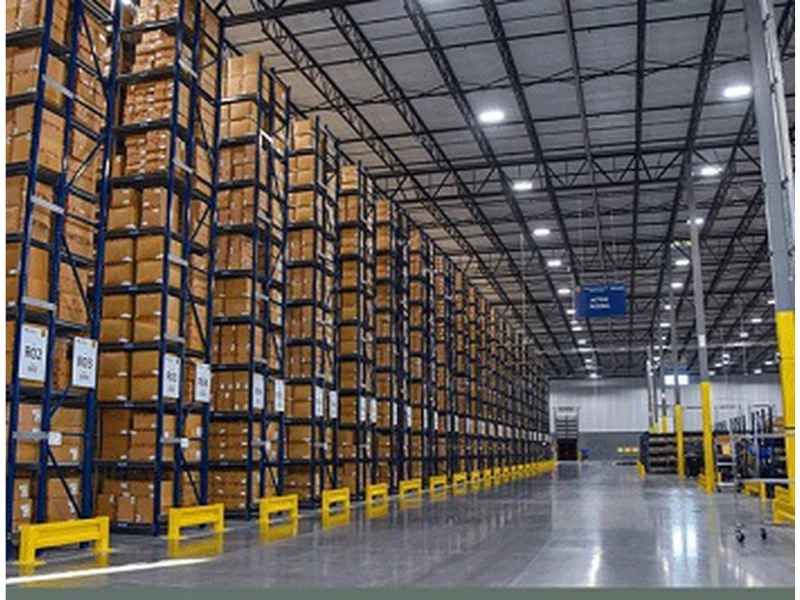
These upgrades help companies reduce operational errors, improve safety, and optimize space utilization. Moreover, the shift towards green warehousing incorporating solar power, energy-efficient lighting, and rainwater harvesting is aligning the sector with sustainability goals. Institutional investments in warehousing have grown steadily, with both domestic and global investors showing strong interest. Large funds are backing logistics real estate developers to create high-quality infrastructure. Policies such as the implementation of the Goods and Services Tax (GST) have eliminated interstate barriers, making it easier for companies to consolidate their warehousing operations into larger, centralized hubs. Additionally, the National Logistics Policy aims to reduce the cost of logistics from the current 13–14% of GDP to single digits, which will further support long-term sectoral growth
Given the momentum, industry experts predict that the warehousing sector will maintain a double-digit growth trajectory over the next five years. The integration of multi-modal transport systems, coupled with ongoing infrastructure projects such as the Dedicated Freight Corridors and Bharatmala highways, will enhance connectivity between industrial hubs and consumption centres. This, in turn, will continue to fuel demand for storage facilities across the country.
Q1. What is the key finding of Knight Frank India’s report?
Warehouse demand rose 42% year-on-year.
Q2. What factors drove the increase in warehouse demand?
E-commerce growth, manufacturing, and better infrastructure.
Q3. Which regions saw the highest demand?
Major metro cities and industrial hubs.
Q4. How does this impact the logistics sector?
Boosts investment, jobs, and supply chain efficiency.
Q5. What’s the outlook for the coming year?
Continued strong growth expected in warehouse demand.