


















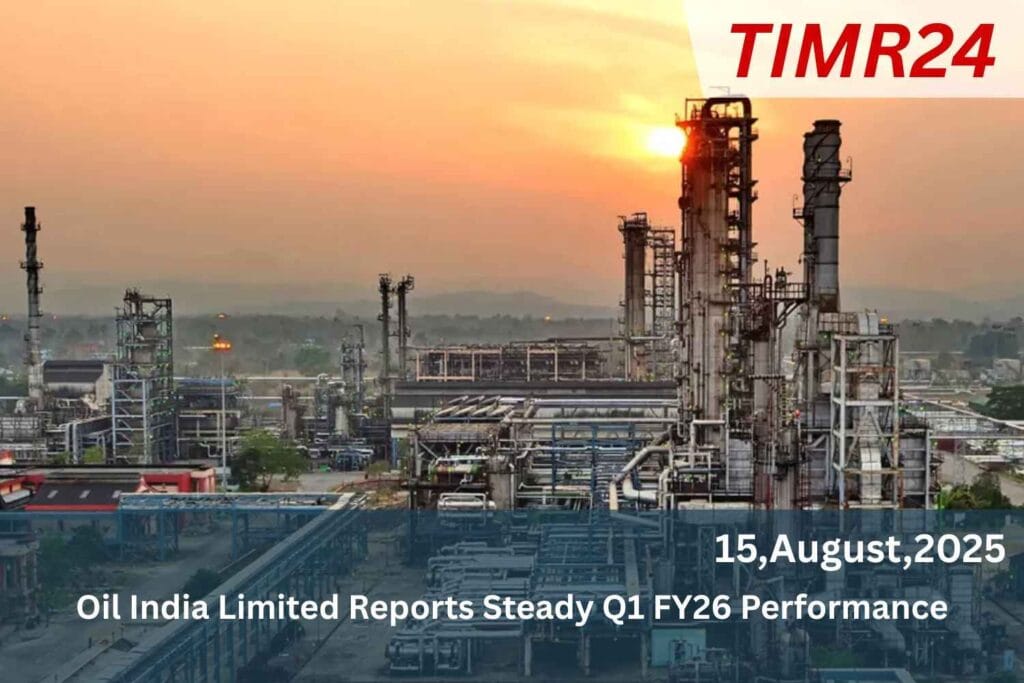
Oil India (OIL), a Maharana CPSE under the Indian Government, reported a consolidated Profit. After Tax (PAT) of Rs 20.46 billion in Q1 FY26, slightly higher than the previous year. The company’s earnings per share (EPS) increased to Rs 11.66 from Rs 11.59 in Q1 FY25. Despite a 22% drop in crude price realisation, OIL maintained strong profitability and continued to invest in exploration and production India Limited a Maharana Public Sector Enterprise under the Government of India, has reported a steady performance for the first quarter of the financial year 2025–26 (Q1 FY26). The company achieved a consolidated Profit After Tax (PAT) of ₹2,046.51 crore.
Slightly higher than ₹2,016.30 crore in the same period of the previous fiscal year. On a standalone basis, the PAT stood at ₹813.48 crore, a decline from ₹1,466.84 crore in Q1 FY25, primarily due to a 22% drop in crude oil price realizations from $84.89 per barrel to $66.20 per barrel Operationally, maintained consistent production levels. Oil and gas output from its mature fields in Northeast India remained stable at 1.680 million metric tonnes of oil equivalent (MMTOE), compared to 1.689 MMTOE in Q1 FY25. The company also made significant strides in exploration and production activities, with a hydrocarbon discovery at.
Despite the challenges posed by lower
The Namrup-Borhat OALP block and the commencement of gas production from the Bakhtinian Discovered Small Field (DSF) block in Rajasthan’s Jaisalmer district In terms of refining operations, Unmilitary Refinery Limited (NRL), a subsidiary of, reported a crude throughput of 799 thousand metric tonnes (TMT) in Q1 FY26, up from 764 TMT in the same quarter of the previous year, reflecting improved operational efficiency crude oil prices, (OIL’s) strategic focus on maintaining production levels, investing in exploration, and enhancing refining capacities has enabled the company to sustain profitability and contribute to India’s energy security.
The steady performance in Q1 FY26 underscores resilience and commitment to its objectives. Financially, ability to manage costs and maintain profitability despite lower crude realizations is a testament to its strategic planning and operational discipline. While crude oil prices during the quarter were lower than last year, careful cost management, efficient production techniques, and a diversified portfolio enabled the company to sustain its earnings. This approach reflects a mature risk management framework and an ability to navigate complex global energy dynamics. Investors and stakeholders can draw confidence from the company’s consistent performance, as it demonstrates resilience against market fluctuations.
Additionally, focus on exploration and technology-driven operations points toward a long-term growth trajectory. The company has been leveraging advanced geophysical techniques to identify new reservoirs and enhance recovery rates from existing fields. Initiatives in digital monitoring, predictive maintenance, and efficient resource management have allowed to reduce operational risks and increase output reliability (Indian Government) These investments also position the company to contribute meaningfully to India’s energy self-reliance, aligning with national goals for energy security and sustainability strategic exploration, and financial prudence. The steady profits, stable production, and efficiency gains across upstream and downstream
Q1. What is Oil India Limited’s Q1 FY26 performance?
Oil India reported steady production and revenue growth in Q1 FY26, maintaining operational efficiency.
Q2. Has Oil India’s production increased?
Yes, production remained stable with slight growth compared to the previous quarter.
Q3. What about Oil India’s revenue in Q1 FY26?
Revenue showed a steady increase driven by consistent oil and gas output.
Q4. Were there any major operational highlights?
The company improved operational efficiency and maintained cost control measures.
Q5. Does Oil India foresee growth in upcoming quarters?
Management expects steady performance and potential growth in the following quarters based on current projects.