









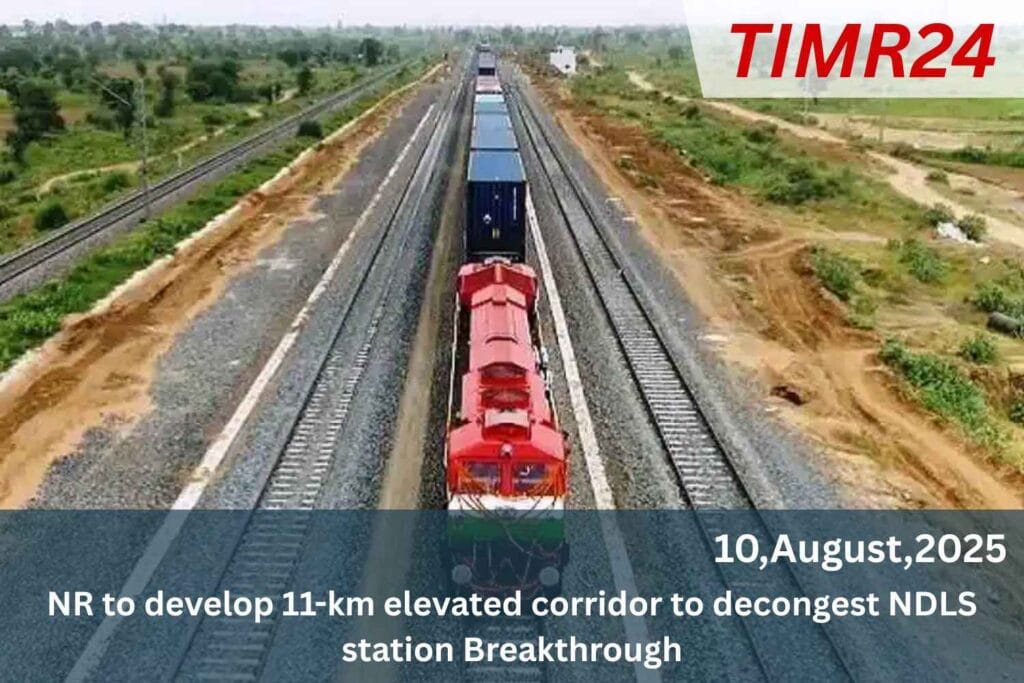
The NR Northern Railways plans to build 11-km elevated road corridors around New Delhi Railway Station, offering multiple entry points and exit ramps. The project includes widening roads around the station area, including Chelmsford Road, Bhavbhuti Marg, Minto Road, Panchkula Road, and Basant Road. The Northern Railway has announced plans to construct an 11-km elevated corridor aimed at easing congestion around the New Delhi Railway Station (NDLS) area. This project is expected to significantly improve traffic flow, enhance passenger convenience, and boost connectivity between key transport hubs in the capital. With NDLS being one of the busiest railway stations in India, accommodating over half a million passengers daily, this initiative is seen as a crucial infrastructure upgrade (Railway Projects).
Project Overview
The elevated corridor will span approximately 11 kilometres, connecting NDLS to major arterial roads and nearby stations. Designed to be a multi-lane structure, it will allow seamless movement of vehicles without interruptions from ground-level traffic. This will help reduce congestion not only in the station vicinity but also in the surrounding Connaught Place and Prayagraj areas.
Expected Benefits
- Reduced Traffic Congestion – By diverting vehicular movement above ground, local traffic bottlenecks will ease.
- Improved Passenger Flow – Easier access to station entry and exit points will enhance commuter experience.
- Better Connectivity – Smooth links to Indira Gandhi International Airport, ISBT Kashmere Gate, and other major nodes.
- Time Savings – The elevated route is expected to reduce travel time by up to 30% during peak hours.
Design and Technology
The corridor will use modern construction techniques such as precast segments to speed up the building process. It will also incorporate smart traffic management systems for efficient vehicle monitoring. Additionally, the design will prioritize pedestrian and cyclist safety by integrating dedicated walkways and lanes. While large-scale infrastructure development often raises environmental concerns has assured that Environmental Impact assessments will be carried out. The project will also focus on minimizing disruption to existing businesses and residential areas during construction. Measures like noise reduction barriers and dust control mechanisms will be implemented. (Railway Infrastructure)
The work is expected to be executed in three phases:
- Core NDLS Zone – Building elevated entry/exit points near Ajmeri Gate and Paharganj.
- Connectivity Extensions – Linking NDLS to the Outer Ring Road and key highways.
- Using fly ash and recycled materials in concrete production.
- Installing LED street lighting for reduced energy use.
- Creating green buffer zones underneath the elevated structure to filter air pollutants.
- Four-to-six lane carriageway for bidirectional flow.
- Ramp access points at critical locations including Connaught Place, Outer Ring Road, and 44.
- Dedicated public transport lanes for buses and emergency vehicles.
Environmental and Social Impact
The project is currently in the planning and approval stage, with construction expected to start within the next year. The estimated cost is yet to be finalized, but officials have indicated that funding will come from both government allocations and possible public-private partnerships. The upcoming 11-km elevated corridor is set to be a transformative step in decongesting New Delhi Railway Station and improving urban mobility in the capital. With modern design, environmental care, and passenger convenience at its core, this project could serve as a model for similar initiatives across the country.
Q1. What is the purpose of the 11-km elevated corridor near NDLS?
To ease road congestion and provide faster, direct access to New Delhi Railway Station.
Q2. Who is developing the elevated corridor?
The project is being developed by Northern Railway.
Q3. How long will the elevated corridor be?
It will be approximately 11 kilometres in length.
Q4. What are the expected benefits of the project?
Reduced traffic jams, quicker travel time, improved safety, and better connectivity.
Q5. When will construction start?
Construction is expected to begin after final approvals, likely within the next year.