

















The Atal Bhujbal Yojana is a comprehensive initiative aimed at improving Groundwater Management in the Atal Jal Gram Panchayats. It involves groundwater measurement and public disclosure, community-led water budgets, and capacity-building trainings. Infrastructure interventions include piezometers, Digital Water Level Recorders, and rain gauges. The scheme has also enabled efficient water-use practices in over 9 lakh hectares. Fund allocation follows a Program for Results model, linking disbursement to state performance. The Yojana emphasizes reviving traditional water structures and has led to the development of innovative models, such as mobile vans for on-the-spot testing, IoT-based precision farming tools, and grassroots water literacy campaigns.
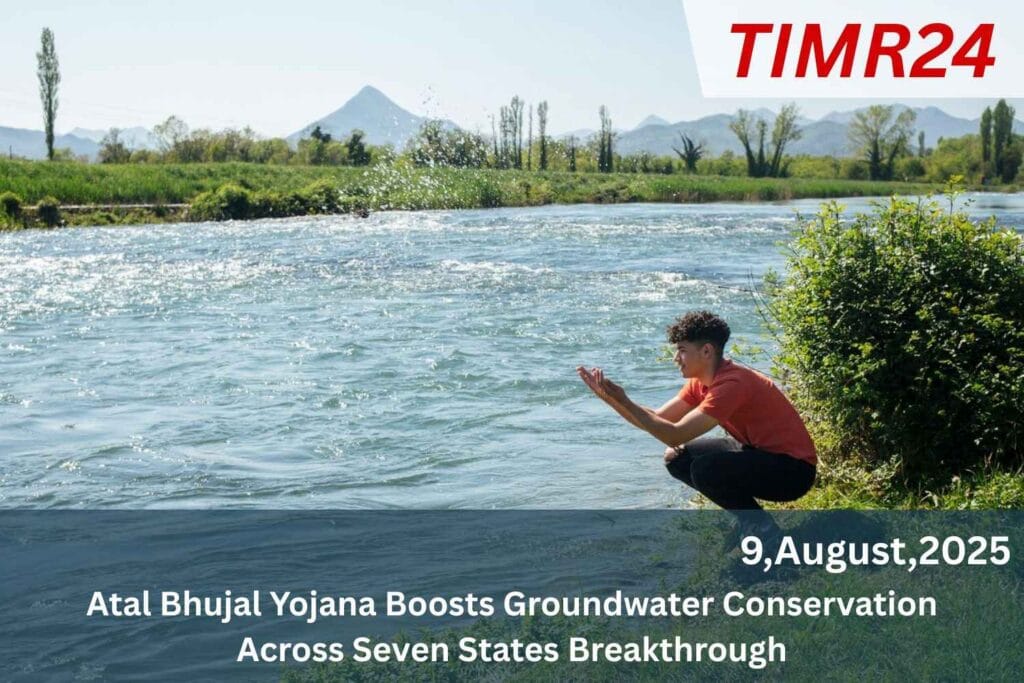
The Atal Bhujal Yojana (ABY), a flagship initiative of the Government of India, has made significant strides in promoting sustainable groundwater management across seven states. The scheme focuses on improving water-use efficiency, reducing over-extraction, and enhancing community participation in water resource planning. Launched in 2019, the Atal Bhujal Yojana is jointly funded by the Government of India and the World Bank, targeting critical groundwater blocks in Gujarat, Haryana, Karnataka, Madhya Pradesh, Maharashtra, Rajasthan, and Uttar Pradesh. Its primary aim is to strengthen institutional arrangements for participatory groundwater management. For background
Overview of the Scheme
The program operates in selected districts across the seven states that face severe groundwater depletion. These areas have been identified using scientific assessments of water table levels and usage patterns. ABY focuses on demand-side interventions, encouraging communities to adopt water-saving technologies, crop diversification, and efficient irrigation methods such as drip and sprinkler systems. For related insights, A defining feature of ABY is its emphasis on Gram Panchayat-led Water Security Plans. Local bodies and farmer groups are actively involved in preparing and implementing strategies to conserve water resources. This participatory model ensures that interventions are tailored to local needs.
Technological Integration
The scheme employs advanced tools like Geographic Information Systems (GIS), remote sensing, and mobile-based monitoring apps to track groundwater levels and usage patterns. These tools help in making informed decisions for water allocation. More details are available in (Technology in Water) Since its launch, ABY has led to the adoption of water-efficient irrigation on thousands of hectares, improved recharge structures, and better awareness among farmers about water budgeting. This has helped slow down the decline of groundwater levels in several targeted areas.
Challenges Ahead
Despite the progress, challenges remain in changing traditional irrigation habits, ensuring long-term maintenance of infrastructure, and dealing with the impacts of climate change on water availability. The Ministry of Jal Shakti aims to scale up the program by including more districts and integrating it with other national water missions. Greater emphasis will be placed on training, community ownership, and convergence with agricultural and rural development schemes The Atal Bhujal Yojana represents a critical step in addressing India’s groundwater crisis, combining scientific approaches with grassroots participation to ensure water security for future generations. (Jal Shakti)
ABY places decision-making power in the hands of Gram Panchayats. Each village prepares its own Water Security Plan, identifying local water challenges, recharge potential, and usage priorities. This participatory model ensures that conservation measures are culturally acceptable and locally viable. The program currently covers Gujarat, Haryana, Karnataka, Madhya Pradesh, Maharashtra, Rajasthan, and Uttar Pradesh — states where over-dependence on groundwater for irrigation has caused steep declines in water tables. These regions were chosen after detailed hydrogeological surveys and water stress mapping.
Q1. What is the main goal of Atal Bhujal Yojana?
To improve groundwater management through community participation in seven states.
Q2. Which states are covered under the scheme?
Gujarat, Haryana, Karnataka, Madhya Pradesh, Maharashtra, Rajasthan, and Uttar Pradesh.
Q3. Who funds the Atal Bhujal Yojana?
It is jointly funded by the Government of India and the World Bank.
Q4. How does the scheme promote water conservation?
Through water budgeting, crop diversification, micro-irrigation, and recharge structures.
Q5. How does it involve local communities?
By engaging Panchayati Raj Institutions, farmers, and water user groups in decision-making.