










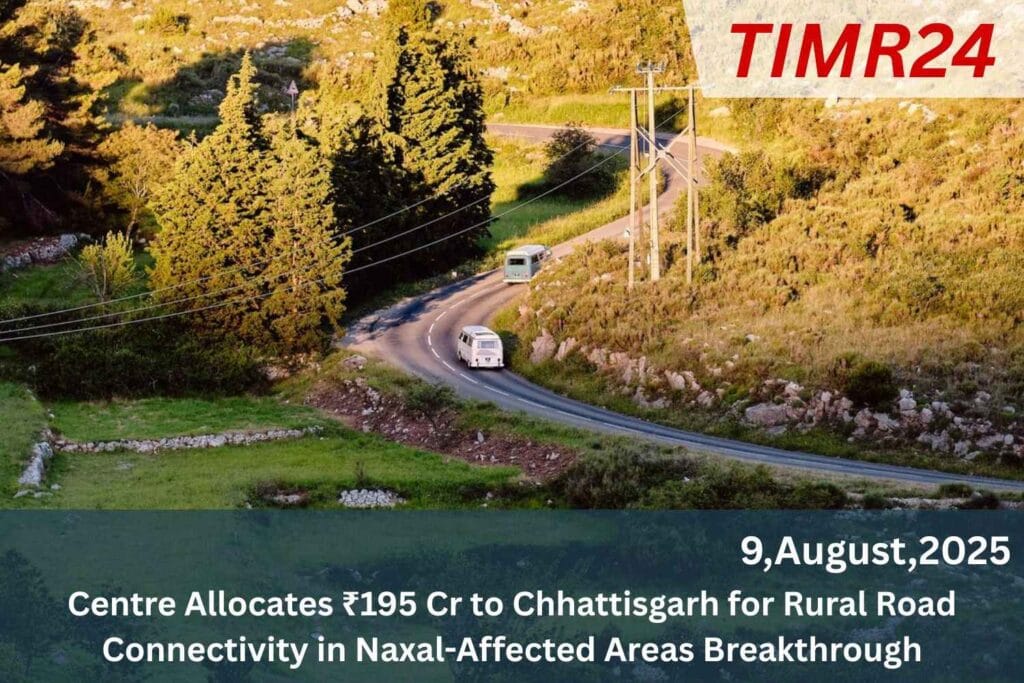
India Rural has approved ₹195 crore for Chhattisgarh under the 2025–26 Road Connectivity Project for Left Wing Extremism Affected Areas (RCPLWEA), aiming to improve rural infrastructure in conflict-affected regions. The funds will support construction, upgradation, and maintenance of rural roads in remote and forested areas. The Ministry of Rural Development urges timely and effective utilization of the funds. The Government of India has approved the allocation of ₹195 crore to Chhattisgarh for improving rural road connectivity in regions affected by Left-Wing Extremism (LWE). This initiative aims to bridge infrastructure gaps, enhance mobility for rural populations, and strengthen security in areas where limited accessibility has hindered socio-economic development.
Objective of the Allocation
The primary objective of this funding is to construct and upgrade rural roads in Naxal-affected districts under schemes such as the Pradhan Mantri Gram Sadak Yojana (PMGSY). Improved connectivity will enable easier access to markets, education, and healthcare facilities for remote communities. It will also help integrate these regions with mainstream economic and social activities. You can learn more about our (Redevelopment Projects ) and their role in uplifting underserved areas.
Targeted Districts and Strategic Impact
The fund will focus on districts most affected by Naxal violence, including Bijapur, Dantewada, Sukma, and Narayan. These regions have long faced challenges due to difficult terrain, sparse infrastructure, and security concerns. By building all-weather roads, the initiative will not only facilitate civilian movement but also improve operational efficiency for security forces in curbing insurgency section explains similar projects across India. Better road connectivity in rural areas plays a transformative role in local economies. Farmers will have quicker access to agricultural markets, students can travel to educational institutions more easily, and healthcare services will become more accessible. This aligns with Chhattisgarh’s vision to empower rural communities through inclusive growth.
Supporting Security Operations
Apart from development benefits, improved road networks in these areas will aid security agencies in faster deployment and logistical support. The Ministry of Home Affairs has repeatedly emphasized that infrastructure is a key component in countering Naxal activities. A secure and connected region is less vulnerable to extremist influence, which in turn fosters long-term stability. For updates on this aspect, The state’s Public Works Department (PWD) will oversee project execution, ensuring quality and timely completion. The Centre will monitor the progress through periodic reviews to ensure funds are used efficiently. Road designs will factor in local geography to withstand heavy monsoon rains and minimize maintenance costs.
The Chhattisgarh Public Works Department (PWD) will execute these projects while adhering to (Indian Roads) Progress will be monitored by the Centre through periodic reviews and geo-tagged project tracking to ensure transparency and quality projects balance growth with environmental protection. The ₹195 crore allocation is more than just a road-building exercise it’s a comprehensive step towards peace, development, and integration in Naxal-affected regions of Chhattisgarh. By addressing infrastructure deficits, the government is laying the foundation for economic resilience, better governance, and enhanced security. The road projects will focus on the worst-affected districts—Bijapur, Dantewada, Sukma, Narayan, and parts of Bastar—where terrain and security challenges have slowed infrastructure development. The Ministry of Home Affairs outlines such efforts in its.
q1. What is the purpose of the ₹195 crore allocation to Chhattisgarh?
To improve rural road connectivity in Naxal-affected areas and link remote villages with all-weather roads.
q2. Which districts will benefit from this project?
Bijapur, Dantewada, Sukma, Narayan, and parts of Bastar.
q3. How will project quality be ensured?
Through geo-tagging, periodic inspections, and joint reviews by the Centre and state.
q4. How will this project impact local communities?
It will boost access to markets, healthcare, education, and improve overall economic opportunities.
q5. Will the project also support security efforts?
Yes, better roads will aid faster deployment of security forces and enhance law enforcement in LWE zones.